Blog · October 20, 2026
Why Visitors Skip Your Email Pop-Up (Play This Instead)
By Peter Mullen
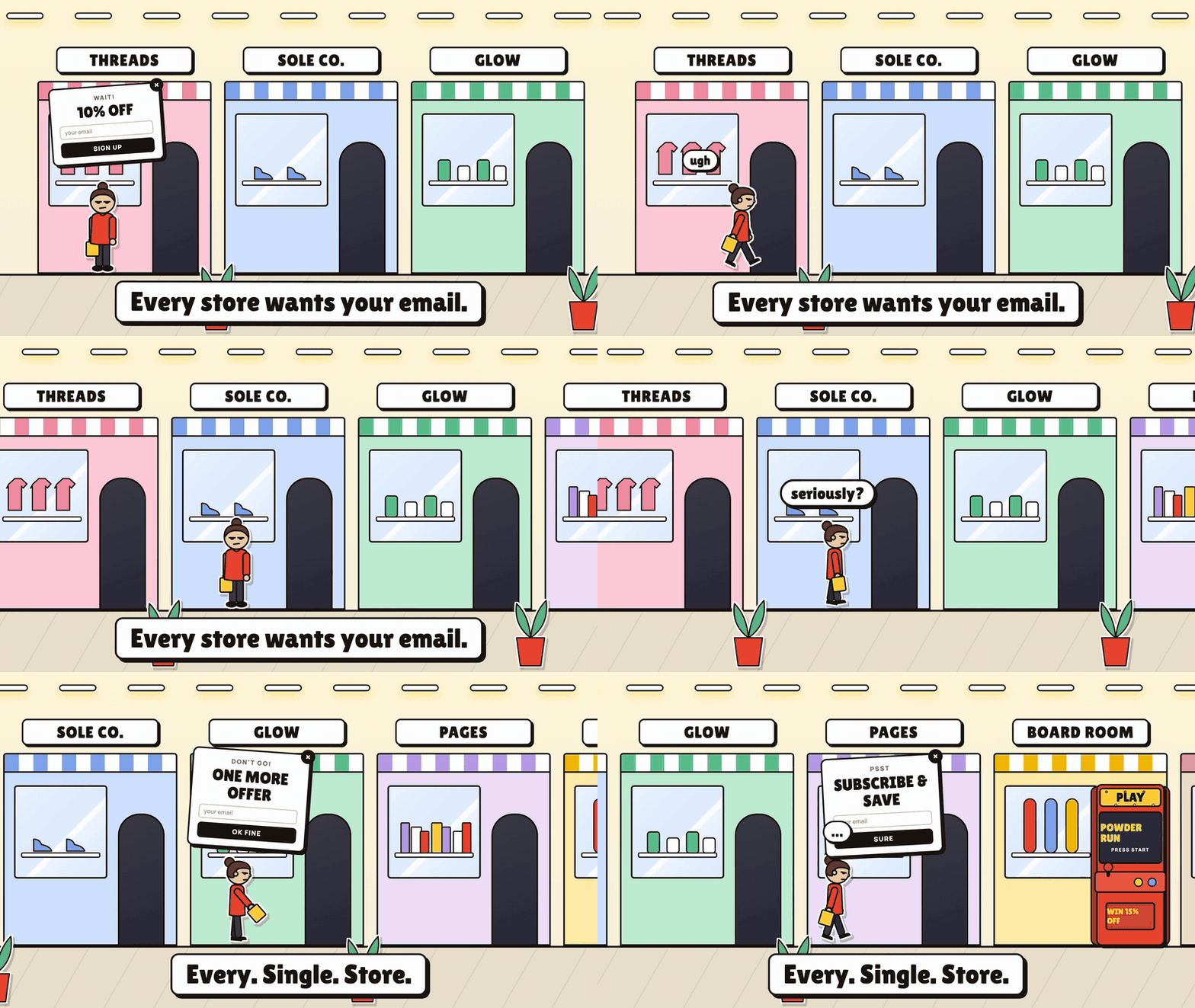
Email pop-ups are the default because they're everywhere, not because they work. Visitors have learned to find the little "x" before they've even read what you're offering. The real alternative isn't a better pop-up — it's something people choose to engage with on their own: a short, playable game on your site that asks for an email after someone's already having fun, not before.
The pop-up everyone closes without reading
A pop-up interrupts. It shows up uninvited, asks for something personal, and gives nothing in return except a vague promise of "10% off." Visitors have seen this exact pattern hundreds of times, and the instinct is automatic: close it, then keep browsing like it never happened.
The deeper problem is the order of operations. You're asking for the email before you've given anyone a reason to want to stay. That's backwards. Nobody hands over contact info to a stranger just because the stranger asked nicely with a countdown timer attached.
Swapping "15% off" for a spin-to-win wheel doesn't fix this — it's the same transaction wearing a different costume. See Arcadette vs spin-to-win popups for the specific differences, but the short version: a wheel is still a form in disguise. It still shows up before trust is earned, and it still asks instead of offers.
The 30-second version
If you want the short version before reading the rest of this: hit play on the hook video. Thirty seconds, best with the sound on, and it shows the whole idea — a game loads on a storefront, a visitor plays instead of closing a tab, and an email shows up on the other side of a score. That's the entire pitch. Everything below is just the why.
The flip: nobody fills out a form, but everyone chases a score
People are allergic to forms. They are not allergic to games — arcades were a business for a reason, and the appeal hasn't changed, it just moved to a phone. Give someone a goal (beat this score, get three tries, unlock a prize) and they'll engage out of genuine interest. Ask them to fill out a field labeled "Email Address" and they'll bounce.
The mechanism is simple: a form has no stakes. A game has a score, a leaderboard, a "one more try," and HI-SCORE sitting right there daring you to beat it. Email capture stops being the ask and becomes the unlock — you play, you post a score worth bragging about, and that's the moment it makes sense to leave an email behind.
What we've actually seen
This isn't theory. Stores using Arcadette are already seeing it lead to sales, not just emails sitting in a list. That's the pattern Arcadette is built around: play comes first, and the sale follows it rather than getting bolted onto a pop-up.
The numbers on the pop-up side are well known. Sumo, which ran email pop-ups across millions of sites, puts the average email opt-in rate at about 2%, measured across more than 3.2 billion pop-up views. Put the other way: about 98 of every 100 people who see one close it. That's the baseline a game is up against.
If you think in funnels and conversion rates, the read is straightforward: a pop-up optimizes for interruption. A game optimizes for attention, and attention is the scarcer resource.
Why a game earns an email a pop-up can't
Three things a pop-up structurally cannot offer:
- Choice. Nobody is forced to play. They opt in, which means the people who do are self-selecting for interest — a warmer list than one built on closing an exit-intent trap.
- A goal. A score gives the visitor something to care about besides the discount. The email becomes a side effect of chasing HI-SCORE, not the point of the interaction.
- A reason to come back. A discount code gets used once. A score invites a rematch — CONTINUE? isn't just arcade flavor, it's the actual loop that brings someone back to beat their own number.
A pop-up can offer a discount. It cannot offer any of those three. That's the gap a game fills.
How to put one on your site this week
You don't need a dev team or a six-week build. If you're on Shopify, Put a game on your Shopify store covers install end to end — it's built for stores first, so setup assumes a storefront, not a custom integration project.
From there:
- Paste your site's address on Arcadette (or describe the game you want). Three ideas come back, built from your logo, colors and products. They're free.
- Pick one and insert a coin. You start with five free build coins, and the game is ready in about a minute. Want to see what they look like first? Play a few in The Arcade.
- Decide what a high score unlocks: a code at each score tier, say 10, 15 or 20 percent off.
- Be plain about what you're asking for when the email field shows up. No fine print, no forced opt-in, no dark patterns — a player who wants to keep their score gives you the email because it's useful to them, not because the game tricked them into it.
Making a game and sharing its own play page is free. Putting it on your own site starts at $15 a month (Pricing), and it's always free to play for your visitors.
Put a game on your site.
Paste your website’s address. Free to make and share.